From Quick Fixes to Pro-Grade Builds: A Complete Guide to Harfington Hardware
When a project hinges on the right part arriving on time, the difference between success and frustration often comes down to where you source your components. That’s where hardware shopping that’s organized, searchable, and reliability-focused shines. With a deep mix of DIY essentials and industrial accessories, Harfington brings together thousands of categories—spanning fasteners, electronic components, auto fittings, hand tools, lighting parts, security gear, and garden supplies—so you can find what you need without hopping between multiple vendors.
Whether you’re restoring a desk lamp, upgrading a home office, maintaining a production line, or keeping a field service kit stocked, a single, well-structured catalog helps reduce delays and return cycles. Instead of treating “hardware” as just screws and sockets, this platform aligns tools, repair supplies, and cross-category parts around practical use cases: maintenance, replacement, improvement, and customization. Browse, filter, compare, and buy—then get back to building. For the full catalog, explore harfington hardware.
What Makes Harfington Hardware Different: Breadth, Compatibility, and Everyday Practicality
The first standout is breadth. A true one-stop shop doesn’t only stock generic pieces; it anticipates the long tail of needs—from M3 and M4 machine screws and NEMA-rated enclosures to USB-C adapters, solder tips, terminal blocks, and automotive clips. This depth matters because real-world projects rarely stay confined to a single aisle. You might start with a fastener and discover you also need a wire ferrule, a heat-shrink assortment, or a gasket. A broad, logically organized catalog keeps these dependencies within reach and reduces cart fragmentation.
Compatibility is the second pillar. Good hardware isn’t just durable; it fits. Matching thread pitches, connector standards, voltage ratings, and material grades prevents waste and rework. On a platform that spotlights spec-driven filters—like diameter, length, material, finish, IP rating, temperature tolerance, and load capacity—you can dial in parts that align with OEM requirements or a maker’s prototype constraints. This is especially important for electronics parts (capacitors, headers, cables) and lighting components (drivers, sockets, LED modules), where specs define safety and performance.
Third is everyday practicality. Projects don’t wait, and neither should your cart. A good hardware marketplace emphasizes stock visibility, consistent pricing, and ready-to-ship options so teams can plan maintenance windows and individuals can schedule weekend builds. When an online store is built around ease of discovery, the effect is multiplicative: predictable ordering reduces downtime, standardized parts simplify future replacements, and clear categorization shortens the learning curve for newer DIYers.
Finally, variety doesn’t mean complexity if navigation is thoughtfully designed. Whether you’re browsing garden improvement supplies like hose fittings and anchor stakes or digging into security items—locks, cable ties, motion sensor brackets—the emphasis stays on helping you translate a task list into a shippable parts list. That supports the full spectrum of users: seasoned maintenance techs, side-hustle tinkerers, facility managers, or students building their first kit.
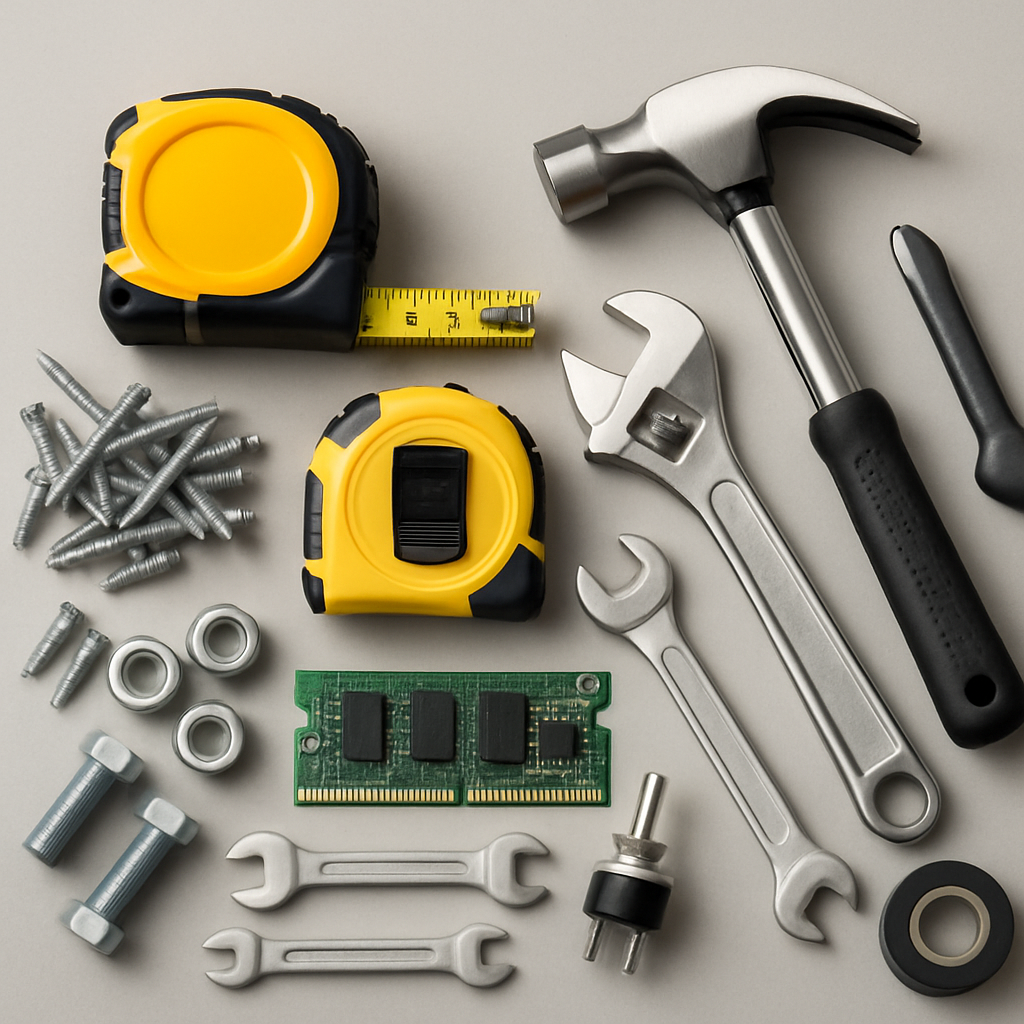
How to Choose the Right Components for DIY, Repair, and Industrial Maintenance
Picking the ideal part starts with clarity on use case, environment, and constraints. For fasteners, consider the substrate, load, and conditions. Indoor furniture assembly typically calls for wood screws or machine screws with matching inserts, while outdoor builds benefit from stainless steel or galvanized finishes to resist corrosion. Machinery brackets or enclosures often demand grade-rated bolts and lock washers, paired with thread-locking compounds where vibration is expected.
For electronics components, identify the interface and rating first. If you’re repairing a device, match voltage and capacitance on capacitors, check pin pitch on headers, and verify connector standards (USB-C, JST, Molex). Keep thermal profiles in mind for lighting projects: LED modules and drivers must align on current and wattage, with heat sinks or thermal pads to maintain luminous efficiency and longevity. In all cases, consider the whole stack—wire gauge, insulation type, ferrules or crimp terminals, strain reliefs, and enclosure IP ratings. A well-chosen accessory stops a repair from failing six weeks later.
When selecting tools, align on precision and durability. A maker’s bench might prioritize ESD-safe tweezers, a temperature-controlled soldering station, and a torque-limited screwdriver set. Field technicians may prefer multi-bit ratcheting drivers, compact crimpers, portable test leads, and impact-rated sockets. The right kit isn’t just about having more tools; it’s about choosing task-appropriate ones that reduce fatigue, speed up work, and prevent damage.
Auto and garage tasks benefit from component compatibility and rugged build quality. Replacement clips, O-rings, hose clamps, and fuses should match OEM specs. For computer accessories and office upgrades, think in terms of cable management, surge protection, ergonomic brackets, and storage hardware—small improvements that yield big usability gains. In security and access, pair the physical with the digital: a sturdy hasp or lock is more effective when supported by cable organization, tamper-evident seals, and weather-appropriate housings.
Industrial or facility maintenance introduces MRO principles: standardize on a core set of repair supplies—assorted fasteners, bearings or bushings, lubricants, gaskets, switches, relays, and safety signage—so common issues have on-hand solutions. Build a replenishment cadence based on mean time between failures and seasonal workloads. In this environment, documentation matters: keep part numbers, datasheets, and refill levels easy to reference so downtime shrinks and audits become straightforward. Thoughtful selection upfront reduces long-term total cost of ownership by minimizing emergency purchases and machine stoppages.
Real-World Scenarios: Home Fixes, Maker Projects, and Facility Upgrades That Benefit from Smart Sourcing
Weekend home improvement: A loose banister and flickering porch light seem unrelated until you realize they share a theme—mismatched parts. The banister repair succeeds with the right lag screws, anchors sized to the wall type, and a stubby driver for tight spaces. The porch light stabilizes with a new LED driver matched to current and wattage, a weather-rated junction box, and stainless mounting hardware to beat coastal humidity. By filtering for finish, diameter, and IP rating, you avoid cracked plaster, burnt-out drivers, and repeat climbs up the ladder.
Maker electronics bench: A hobbyist revives a retro handheld console by swapping a swollen capacitor pack, reflowing a cracked header, and replacing a broken switch. The fix holds because each component matched voltage, tolerance, pin spacing, and actuator height. Adding heat-shrink tubing for strain relief and an ESD mat prevents future failures during mods. The same bench later upgrades a 3D printer with a quieter cooling fan, silicone bed spacers, and ferrules on high-current leads to eliminate stray strands. The result: better thermals, cleaner prints, and fewer intermittent resets.
Small manufacturer MRO: A packaging line faces intermittent downtime due to a single cracked cam follower and a slipping belt. Stocking a preventive kit—spare bearings, tensioners, thread-lockers, retaining rings, and metric fastener assortments—shrinks response time from hours to minutes. A labeler’s cabinet also gets rewired with ferruled conductors and DIN-rail terminals to improve serviceability. Across a quarter, planned micro-stoppages replace surprise breakdowns, and overtime spend drops even with the same headcount.
Office and workstation upgrades: A remote team transforms a cluttered spare room into a productive space using cable trays, VESA monitor arms, adhesive hooks, and low-profile surge protectors. An aging desk lamp gets a new LED module and switch, restoring function and style. Adding weatherstripping and door sweeps cuts noise transfer for better focus during calls. These inexpensive accessories do more than tidy up—they reduce friction, eye strain, and troubleshooting time, leading to measurable productivity gains.
Automotive care and garage organization: A DIYer tackles a brake light issue by replacing a corroded socket and using dielectric grease to protect contacts. Replacement push clips and panel fasteners eliminate rattles after a stereo upgrade. Pegboard hooks, labeled bins, and magnetic trays turn a chaotic toolbox into an efficient station where the right bit and driver appear on the first try. With properly rated fuses, heat-resistant loom, and cable ties, under-hood wiring stands up to heat and vibration.
Smart home and security: An entryway camera mount finally sits flush thanks to masonry anchors sized for brick, a bubble level, and a secure cable pass-through with a grommet to avoid chafing. Indoors, a motion sensor becomes more reliable after relocating it with a bracket that avoids HVAC vents and direct sunlight. Asset tags and tamper-evident seals help teams manage loaner equipment without guesswork. Pairing the right security items with cable discipline elevates reliability more than any single gadget upgrade.
Garden and outdoor fixes: A hose bib reinforcement uses exterior-rated screws and a UV-stable bracket to survive seasonal swings. Raised bed corners square up with corner braces and corrosion-resistant bolts. A shed door latch aligns smoothly after swapping in shims and a new strike plate. In each case, materials matter: stainless or coated hardware, weather-rated enclosures, and UV-resistant plastics fight sun, rain, and freeze-thaw cycles that would destroy indoor-only parts.
Across these scenarios, the common denominator is a supply that treats parts as building blocks in real workflows. When a catalog integrates fasteners, electronics parts, auto clips, office and computer accessories, lighting and security components, plus garden improvements, it enables confident, end-to-end solutions. That confidence shortens project timelines, reduces rework, and makes it easier for both individuals and teams to go from problem to finished fix with fewer unknowns.

Accra-born cultural anthropologist touring the African tech-startup scene. Kofi melds folklore, coding bootcamp reports, and premier-league match analysis into endlessly scrollable prose. Weekend pursuits: brewing Ghanaian cold brew and learning the kora.
About The Author

Kofi Mensah
Accra-born cultural anthropologist touring the African tech-startup scene. Kofi melds folklore, coding bootcamp reports, and premier-league match analysis into endlessly scrollable prose. Weekend pursuits: brewing Ghanaian cold brew and learning the kora.