Sparkle at Scale: How AI Jewellery Product Photography Is Redefining Visual Content for Luxury Brands
What Makes AI Jewellery Product Photography Different—and Better
Jewellery product photography is notoriously difficult. Metals behave like mirrors, gemstones bend and split light, and tiny imperfections become glaring at macro scale. Achieving accurate reflections, crisp facets, and true-to-life metal tones usually requires specialist lighting, a controlled studio, and extensive retouching. AI jewellery product photography changes that equation by combining physically informed rendering with learned visual priors, so the final image looks like it was shot by a veteran studio team—without the friction of a traditional set.
At its core, AI-driven imagery models how light interacts with materials central to fine jewellery: polished gold and platinum, brushed finishes, pavé settings, prong detail, and gemstone dispersion for diamonds, sapphires, and emeralds. These systems simulate or infer micro‑highlights, edge roll‑off, and occlusion in crevices, then harmonize them under curated lighting “recipes.” The result is a consistent, high‑end look that doesn’t drift from one SKU to the next. Because parameters are saved as reusable presets, it’s easy to maintain a single brand aesthetic across packshots, on‑model frames, and lifestyle scenes—even as new collections drop weekly.
Speed is another leap forward. Instead of booking a studio, shipping samples, and waiting for retouch, teams can start from sketches, CAD files, or existing product photos. A drag‑and‑drop studio surface and smart editing tools let users adjust camera angle, focal length, depth of field, and lighting positions in minutes, then swap backgrounds or props without reshoots. For e‑commerce, 2K output more than covers PDP zoom; for print or hero assets, 4K imagery preserves prong edges and facet fire beautifully.
Equally important is cost and scalability. AI pipelines reduce the marginal cost of each new image, which is crucial as brands offer more sizes, metals, and stone combinations. Variant creation becomes a few clicks instead of a new day rate. Platforms purpose‑built for AI jewellery product photography condense this complex pipeline into a coherent workflow, so artisans, designers, and established houses can all produce studio‑quality visuals at the pace modern retail demands.
From CAD to Campaign: Workflows and Use Cases for Brands and Artisans
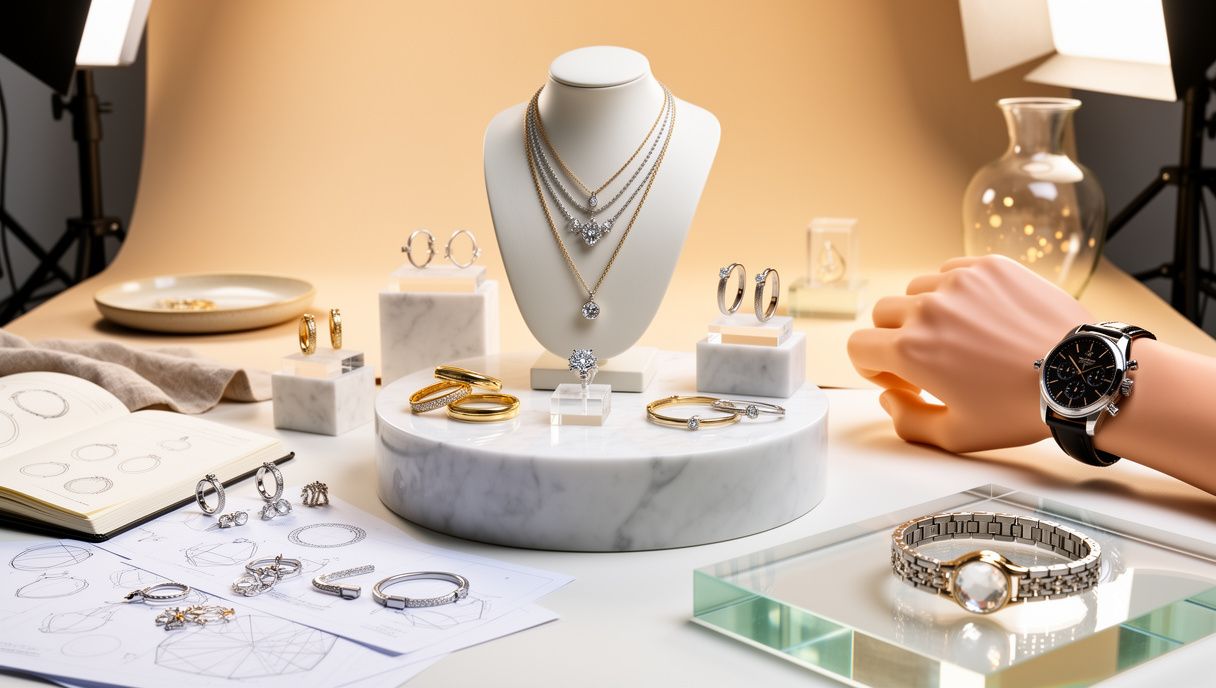
An effective AI workflow mirrors the creative process from concept to launch, but removes the production bottlenecks. A typical path begins with material‑accurate inputs: a CAD model for unreleased pieces, or a few clean reference photos for items already in hand. The system maps materials—yellow, white, or rose gold; platinum; rhodium finishes—and calibrates gemstones for color, clarity, and cut. With that foundation, lighting scenes are applied: a soft three‑point studio setup for packshots on white, a moody single‑key for editorial, or a daylight window effect for natural warmth.
For e‑commerce readiness, the AI ensures consistent angles, shadow styles, and canvas sizes. Standard PDP frames—front angle, side angle, detail crop—are rendered to spec, with transparent PNGs for marketplace compliance. Macro choices matter: a longer focal length reduces distortion in hoop earrings; a tighter depth of field adds dimensionality to solitaire rings while keeping the shank legible. Because presets are versioned, revisions are controlled: if the brand moves to a cooler white balance or a softer backlight, the entire catalog can be updated in batch for a unified storefront.
Campaign imagery builds on that base. Lifestyle scenes place products on curated surfaces—travertine, velvet, lacquer—under lighting that matches the season. On‑model frames can be generated to show scale and fit on hands, necklines, and earlobes across a range of skin tones. This reduces expensive talent bookings for every colorway while keeping creative control tight. Social teams benefit from fast variation: square crops for feeds, vertical 9:16 for stories and reels, wides for web banners—all consistent with the core look.
Real‑world scenarios show the flexibility. An independent jeweller releasing a bridal line can turn CADs into a 4K lookbook over a weekend, validating demand before casting every piece. A DTC microbrand can deploy 50 ring variants in multiple metals without scrambling for studio slots. Regional retailers can localize imagery—a beach‑glass summer motif for Brighton, a sleek marble winter set for Copenhagen—without shipping inventory. In each case, AI jewellery product photography compresses time‑to‑market and multiplies content per SKU, which directly supports faster launches and richer omnichannel storytelling.
Quality, Realism, and SEO: Optimizing AI Images for E‑commerce Performance
Realism is non‑negotiable in luxury. To maintain trust, prioritize color‑managed exports and accurate scale. Calibrate metal warmth so rose gold doesn’t skew too pink; ensure diamond fire looks lively but not synthetic; retain micro‑details such as claw tips and milgrain. For earrings and necklaces, verify drop length and pendant size against measurement callouts. Many teams include a “true scale” frame next to a coin or ruler, then keep hero images purely aspirational. This balance of beauty and clarity reduces returns and supports informed purchases.
Technical delivery matters as much as aesthetics. For product detail pages, generate 2K frames for zoom and pristine 4K masters for print. Export WebP or AVIF for speed, with PNG reserved for transparency. Keep file weights in check with thoughtful denoising and compression, and standardize aspect ratios across categories. Consistent naming (collection_sku_view_variant) and versioning help teams track updates as stones or settings change. Where marketplaces impose rules—white background, 85% frame fill—use AI presets to stay compliant automatically.
Search performance improves when images are paired with rich, accurate metadata. Write alt text that highlights cut, metal, and stone type (e.g., “18K yellow gold pavé halo engagement ring with oval diamond”). Use structured data on PDPs to reinforce availability, price, and material specs. Consider producing supporting visuals—assembly diagrams, prong close‑ups, clasp macros—to target long‑tail queries such as “lobster clasp vs spring ring” or “shared prong pavé”. Faster page loads from optimized images reduce bounce and support higher conversion, a virtuous cycle for both UX and SEO.
Ethics and transparency also play a role. If renders depict unreleased designs, label preorder status clearly; if stones are lab‑grown, state it in captions. For social creatives, maintain consistency between hero visuals and in‑box reality to preserve brand equity. Teams adopting concept‑to‑reality workflows often add a post‑launch refresh: once the first sample is cast, they validate metal hue and facet behavior, then batch‑update masters in minutes. Across these steps, AI jewellery product photography functions as a creative multiplier—delivering scalable visuals for e‑commerce, social, and print while meeting the quality bar luxury buyers expect.

Accra-born cultural anthropologist touring the African tech-startup scene. Kofi melds folklore, coding bootcamp reports, and premier-league match analysis into endlessly scrollable prose. Weekend pursuits: brewing Ghanaian cold brew and learning the kora.
About The Author

Kofi Mensah
Accra-born cultural anthropologist touring the African tech-startup scene. Kofi melds folklore, coding bootcamp reports, and premier-league match analysis into endlessly scrollable prose. Weekend pursuits: brewing Ghanaian cold brew and learning the kora.